

Blog
How Advanced PCB Design Can Reduce the Need for Additional Heat Sinks
Thermal management is one of the most important challenges in modern electronic design. As devices become more powerful, compact, and feature-rich, the amount of heat generated within printed circuit boards continues to increase. Excessive heat can reduce performance, shorten component lifespan, create reliability issues, and ultimately lead to system failure. This is where heat sinks can be beneficial, but only to a small extent.
Traditionally, engineers have addressed thermal concerns by incorporating external heat sinks into their designs. While heat sinks remain valuable in many applications, advances in PCB design and manufacturing have made it possible to dissipate heat more effectively through the board itself. In many cases, a well-engineered PCB can significantly reduce — or even eliminate — the need for additional heat sinks.
For OEMs developing products in aerospace, medical, telecommunications, industrial automation, and defense applications, understanding the relationship between PCB design and thermal performance can lead to more reliable systems, lower costs, and simplified manufacturing.
Why Thermal Management Matters
Every electronic component generates heat during operation. Power supplies, processors, amplifiers, voltage regulators, and high-current circuits are especially prone to elevated temperatures.
When heat is not effectively managed, several problems can occur:
- Reduced component lifespan
- Signal integrity issues
- Increased risk of premature failures
- Lower overall system reliability
- Reduced performance due to thermal throttling
- Increased maintenance and warranty costs
In high-reliability industries, these risks are unacceptable. Thermal management must be addressed during the design phase rather than treated as an afterthought.
The Traditional Role of Heat Sinks
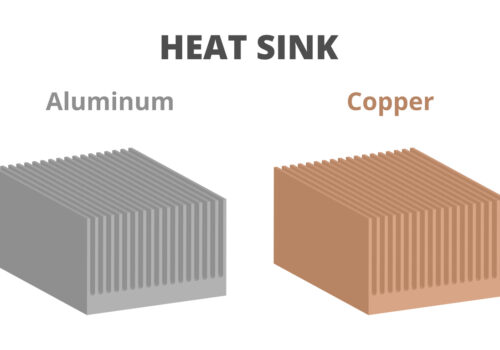
Heat sinks are designed to absorb and dissipate heat away from electronic components. They increase surface area and improve heat transfer into the surrounding environment.
While effective, heat sinks introduce several design considerations:
- Additional material costs
- Increased assembly complexity
- Larger product footprints
- Higher overall system weight
- Additional mechanical mounting requirements
- Potential points of failure
For compact or weight-sensitive applications, minimizing external thermal management components can provide significant advantages.
How PCB Design Contributes to Thermal Performance
Modern PCB engineering allows the board itself to become part of the thermal management solution.
Rather than concentrating heat in a small area, advanced PCB layouts can distribute and transfer thermal energy throughout the board structure.
Several design techniques contribute to improved heat dissipation.
Thermal Vias
Thermal vias are plated holes that transfer heat from surface-mounted components to internal or opposite copper layers.
These structures create efficient thermal pathways, allowing heat to spread across larger copper areas where it can dissipate more effectively.
Thermal vias are commonly used beneath:
- Power regulators
- MOSFETs
- High-current components
- LED assemblies
- RF power devices
When properly designed, thermal via arrays can dramatically reduce localized hot spots.
Heavy Copper Construction
Copper serves as both an electrical conductor and a thermal conductor.
Using heavier copper weights allows heat to move more efficiently through the PCB. This can be especially beneficial in power electronics, industrial controls, and telecommunications equipment where current loads are significant.
Heavy copper designs can:
- Improve heat distribution
- Reduce temperature gradients
- Increase current-carrying capacity
- Improve long-term reliability
Optimized Copper Planes
Strategically designed copper pours and planes act as built-in heat spreaders.
Large copper areas distribute thermal energy across the board rather than allowing it to accumulate near individual components. Engineers can leverage internal layers and ground planes to create highly effective thermal pathways without adding mechanical cooling hardware.
Metal-Core PCB Technologies
Certain applications benefit from metal-core PCB (MCPCB) construction, where an aluminum or other thermally conductive substrate helps move heat away from critical components.
These designs are frequently used in:
- LED lighting systems
- Power conversion equipment
- Automotive electronics
- Industrial control systems
Metal-core technologies can provide thermal performance that would otherwise require substantial heat sink assemblies.
Component Placement and Layout Optimization
Thermal management begins with thoughtful component placement.
High-power devices should be positioned to avoid concentrated heat zones. Designers must consider airflow patterns, thermal coupling between components, and proximity to sensitive circuitry.
Effective layouts often result in lower operating temperatures without requiring additional thermal hardware.
Benefits of Reducing Heat Sink Dependence
When thermal performance is designed directly into the PCB, manufacturers and OEMs can realize several advantages.
Smaller Product Designs
Eliminating or reducing external heat sinks enables more compact assemblies.
This is especially valuable in aerospace, telecommunications, medical devices, and portable electronics where space constraints are critical.
Lower Material and Assembly Costs
Fewer thermal management components mean:
- Reduced bill of material costs
- Fewer assembly operations
- Simplified supply chains
- Lower inventory requirements
Over high-volume production runs, these savings can become significant.
Improved Reliability
Every additional mechanical component introduces potential failure points.
By integrating thermal management into the PCB design itself, engineers can reduce mechanical complexity and improve long-term reliability.
This is particularly important in mission-critical environments where maintenance opportunities may be limited.
Reduced Weight
Weight reduction remains a priority in aerospace, defense, transportation, and portable equipment applications.
Removing large aluminum heat sinks can contribute meaningfully to overall system weight reduction while maintaining thermal performance objectives.
Manufacturing Precision Matters
Effective thermal design depends not only on engineering but also on manufacturing consistency.
Features such as thermal vias, heavy copper layers, controlled stackups, and specialized materials require precise fabrication processes. Variations in plating quality, copper thickness, or layer registration can directly impact thermal performance.
This is why manufacturers serving high-reliability industries place strong emphasis on:
- Process control
- IPC-compliant manufacturing standards
- Material traceability
- Documentation and inspection procedures
- Design-for-manufacturability reviews
Thermal performance designed into the PCB must be consistently reproduced from prototype through full production.
Engineering Collaboration Drives Better Thermal Outcomes
Reducing reliance on external heat sinks often requires collaboration between design engineers and PCB manufacturing experts early in the development process.
Manufacturing teams can help identify opportunities to improve thermal efficiency through:
- Stackup optimization
- Material selection
- Copper balancing strategies
- Via design recommendations
- Manufacturability improvements
Early collaboration frequently leads to better thermal performance while avoiding costly redesigns later in the product lifecycle.
Partnering with CircuiTek Solutions for High-Reliability PCB Performance
Thermal management is no longer limited to adding larger heat sinks or external cooling systems. Through advanced PCB design techniques, engineers can improve heat dissipation directly within the board structure, leading to more compact, reliable, and cost-effective products.
At CircuiTek Solutions, thermal considerations are integrated into an engineering-driven manufacturing process built around controlled workflows, IPC-aligned quality standards, full traceability, and scalable production capabilities. From prototype development through volume manufacturing, CircuiTek helps customers build high-performance PCB solutions that meet the demanding requirements of aerospace, medical, industrial, telecommunications, and defense applications.
For organizations seeking to improve thermal performance while reducing design complexity, a carefully engineered PCB may be one of the most effective solutions available.