

Flexible PCB Manufacturer in USA
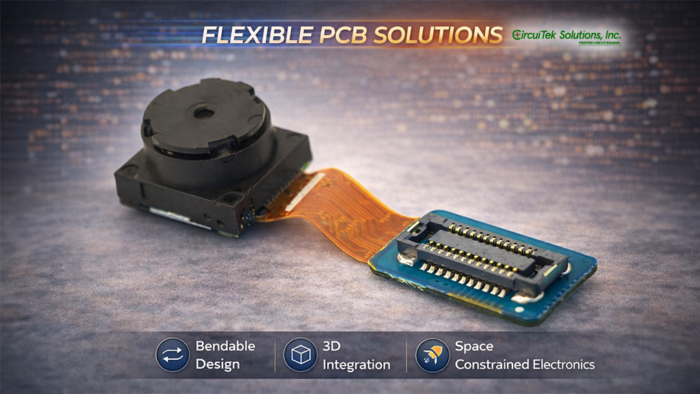
At CircuiTek Solutions, we design and fabricate printed Flexible Printed Circuit Boards that can bend, fold, and conform to complex shapes while maintaining electrical performance. Flexible printed circuit boards—commonly known as flex PCBs—enable compact, lightweight electronics where traditional rigid PCBs cannot fit or perform reliably.
Flex PCBs deliver the same functionality as rigid boards while offering mechanical flexibility, reduced weight, and enhanced reliability in demanding applications.
What Is a Flexible PCB?
A Flexible PCB is a printed circuit board constructed using flexible polymer substrates, allowing it to bend or fold without damaging circuitry. Unlike rigid PCBs made from fiberglass-reinforced epoxy, flex PCBs use materials such as polyimide or polyester to achieve mechanical flexibility.
This flexibility enables:
- Connection of hard-to-reach components
- Integration into compact and irregular spaces
- Elimination of bulky wiring harnesses
- Improved reliability in dynamic environments
Key Features of Flexible Printed Circuit Boards
Flexible PCBs offer structural and performance advantages over traditional rigid boards.
Key features include:
- Physical flexibility without loss of electrical function
- Lightweight and thin construction
- Resistance to vibration and mechanical stress
- Suitability for extreme temperatures and harsh environments
Because flex PCBs reduce connectors and wiring, they also minimize assembly errors and improve long-term reliability.
Materials Used in Flexible PCB Manufacturing
Flexible PCBs rely on specialized materials engineered for durability and performance.
Substrate Materials
Common flexible substrates include:
- Polyimide (PI), also known as Kapton
- Polyester (PET) for lower-temperature applications
- PTFE for high-frequency or chemically resistant designs
Conductive Layers
Conductive layers are typically:
- Copper foil for signal traces
- Copper thickness ranging from 0.5 oz to 2 oz
Adhesives and Bonding Materials
Adhesive systems include:
- Acrylic-based adhesives
- Epoxy-based adhesives
Stiffeners
Stiffeners provide localized rigidity and are commonly made from:
- Polyimide materials
- Rigid FR-4 materials
Surface Finishes
Common surface finishes include:
- ENIG (Electroless Nickel Immersion Gold)
- OSP (Organic Solderability Preservative)
- Immersion Silver
- Immersion Tin
Technical Aspects and Characteristics of Flexible PCBs
Flex PCBs are designed for applications requiring space efficiency and mechanical adaptability.
Key technical characteristics include:
- Ability to bend and fold without electrical failure
- Enhanced airflow for improved heat dissipation
- Resistance to vibration and repeated movement
- Reliable performance under thermal and chemical exposure
These attributes make flex circuits ideal for dynamic and harsh environments.
Design Considerations for Flexible PCBs
Designing flexible PCBs requires specialized engineering practices.
Flexibility and Bend Radius
The bend radius determines how tightly a flex PCB can bend without damage. Proper bend ratios are critical to preventing conductor fatigue.
Dynamic vs. Static Flexing
Dynamic flexing involves repeated movement, while static flexing occurs during installation only. Each requires different design strategies.
Routing and Stress Management
Trace routing must minimize stress concentrations and support long-term mechanical reliability.
Layer Count and Impedance Control
Flex PCBs can be single-layer, double-layer, or multilayer designs, with controlled impedance used for high-speed applications.
EMI Shielding
Shielding techniques are used to manage electromagnetic interference in sensitive designs.
Types of Flexible PCB Constructions
Flexible PCBs are available in several configurations.
Single-Sided Flexible PCB
Defined under IPC-6013 Type 1 specifications, these boards feature:
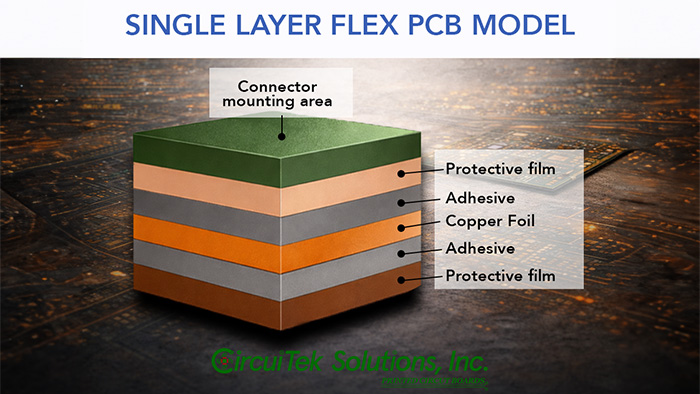
- One copper layer bonded between insulating polyimide layers
- Typical core thicknesses from 0.5 mil to 3 mil
- Finished copper thickness from 1/3 oz to 2 oz
Double-Sided Flexible PCB
Defined under IPC-6013 Type 2 specifications, these boards include:
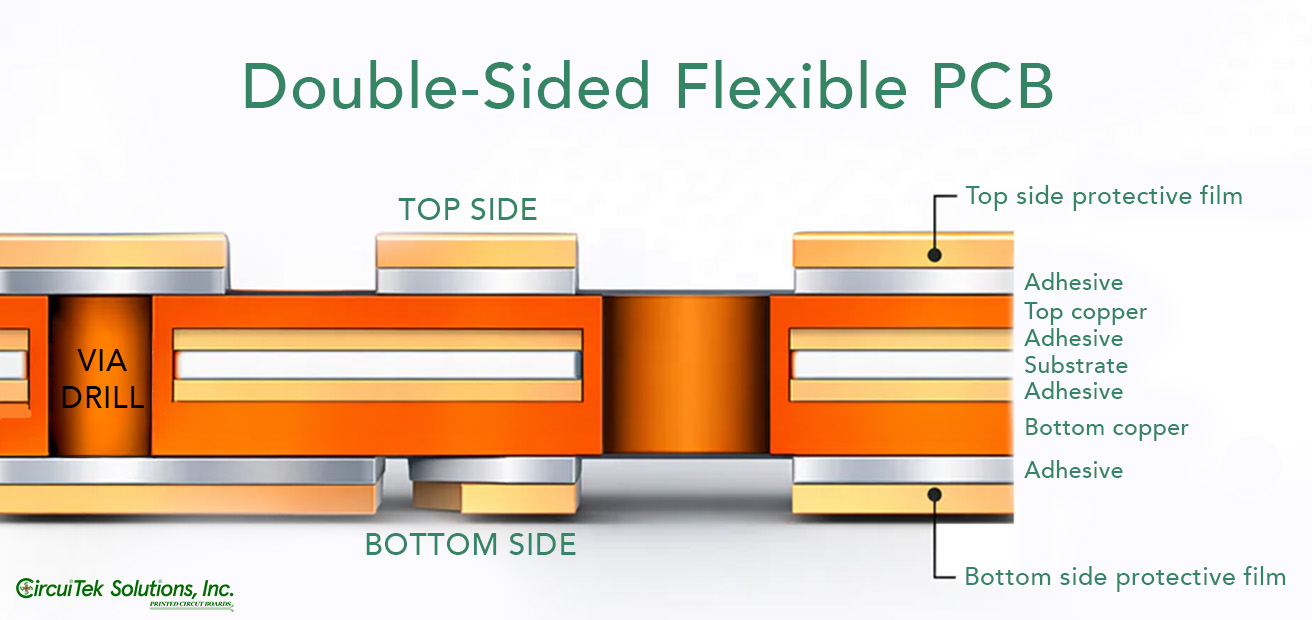
- Two conductive copper layers with plated through-holes
- Polyimide insulation layers on both sides
- Thickness ranges from 0.5 mil to 4 mil
Multi-Layer Flexible PCB
Defined under IPC-6013 Type 3 specifications, these boards feature:
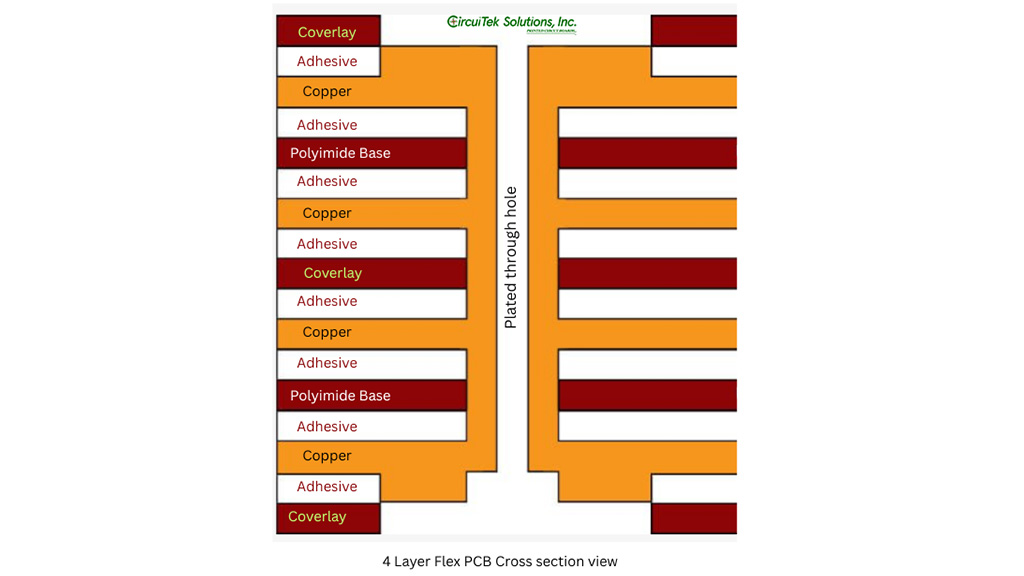
- Three or more conductive layers
- Flexible insulation between each layer
- Plated through-holes for interconnection
These constructions support increasingly complex and high-density designs.
Advantages of Using Flexible PCBs
Flexible PCBs provide multiple performance and manufacturing benefits.
Advantages include:
- Significant weight reduction compared to rigid PCBs
- Space-saving design for compact electronics
- High durability under vibration and mechanical stress
- Improved thermal management through airflow
- Enhanced signal integrity in dynamic applications
- Reduced assembly errors due to fewer connectors
Applications of Flexible Printed Circuit Boards
Flexible PCBs are used across a wide range of industries.
Applications include:
-
Medical devices
such as pacemakers and monitoring equipment
-
Automotive systems
including airbags, displays, and GPS
-
Consumer electronics
smartphones, laptops, and wearables
-
Aerospace
satellite systems
-
Robotics
sensors, automation equipment
-
Military
transportation electronics
Their flexibility and reliability make them essential for modern compact electronics.
Why Choose Circuitek Solutions Inc. for Flexible PCB Fabrication?
Circuitek Solutions Inc. is a trusted Flexible PCB manufacturer in USA, delivering precision-engineered flex circuits for demanding applications.
We specialize in:
- Custom flexible PCB design and fabrication
- Proper bend radius and flex ratio engineering
- Advanced material selection for performance and durability
- IPC-compliant design, manufacturing, and testing
- Quick quotes with competitive pricing
- Reliable turnaround times with transparent communication
Our engineering-led approach ensures each flexible PCB meets performance, reliability, and quality expectations.
EEAT-BASED & SEARCH-DRIVEN
Flexible PCBs use polymer substrates that allow bending and folding, while rigid PCBs use fiberglass materials and cannot flex.
In dynamic environments, flexible PCBs are often more reliable because they reduce connectors, wiring, and vibration-related failures.
Yes. Polyimide-based flex PCBs perform well in high-temperature and harsh environments.
Industries such as medical devices, automotive, consumer electronics, aerospace, robotics, and military systems commonly use flexible PCBs.