

RF / Microwave PCB Manufacturer in USA
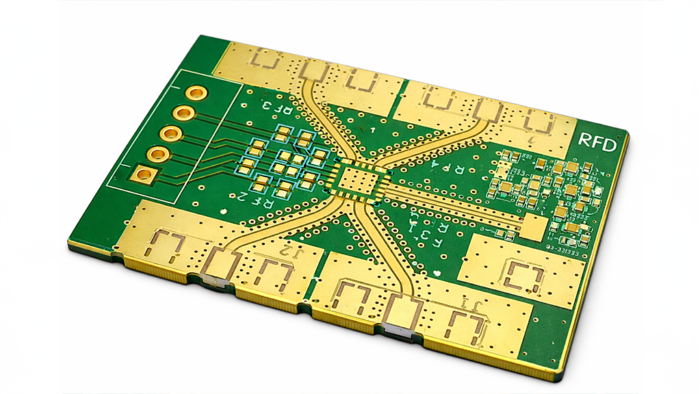
At CircuiTek Solutions, we produce RF/Microwave printed circuit boards capable of handling high-frequency signals with minimal loss and maximum signal integrity. These specialized PCBs are essential in applications where performance is measured in megahertz and gigahertz rather than simple electrical continuity.
RF and microwave PCBs are used in environments where even small deviations in impedance, material properties, or surface finish can significantly impact performance.
What Are RF / Microwave PCBs?
RF and Microwave PCBs are customized printed circuit boards engineered to transmit high-frequency signals, typically operating above 100 MHz for RF and 2 GHz and higher for microwave applications.
These boards are commonly used in:
- Wireless communication systems
- Satellite, radar, and sensing technologies
- Robotics, smartphones, and security systems
- Medical and automotive electronics
Their design prioritizes signal integrity, impedance control, and electromagnetic stability.
Key Characteristics of RF / Microwave Printed Circuit Boards
RF and microwave PCBs are highly sensitive to environmental and electrical variables.
Key characteristics include:
- Sensitivity to impedance variations
- Susceptibility to electromagnetic interference (EMI)
- Sensitivity to electrostatic discharge (ESD)
- Dependence on precise material properties
Because of these constraints, RF and microwave PCBs demand far tighter design and manufacturing control than conventional boards.
Frequency Ranges in RF and Microwave PCBs
RF and microwave PCBs are categorized based on operating frequency.
Typical frequency ranges include:
- RF signals above 100 MHz
- Microwave signals from 1 GHz up to 300 GHz
- Broadcast and antenna applications (FM, TV, radar bands)
- Advanced high-frequency communication systems
These ranges require materials and geometries engineered specifically for signal fidelity.
Materials Used in RF / Microwave PCB Fabrication
Material selection is the most critical factor in RF and microwave PCB performance.
Common materials include:
- Rogers RO4000 series laminates
- Isola IS620 and Astra
- PTFE-based materials
- Hybrid Rogers + High TG FR-4 constructions
Standard FR-4 is generally not recommended for microwave PCB fabrication due to higher dielectric loss at high frequencies.
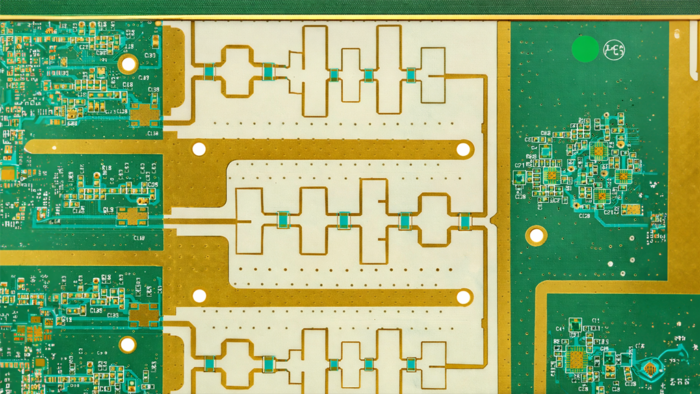
Technical Aspects of RF / Microwave PCBs
RF and microwave PCBs demand precision across multiple engineering disciplines.
Material Selection
Low dielectric constant, low dissipation factor, and high thermal conductivity are essential to maintain signal integrity.
Electromagnetic Compatibility (EMC)
Proper shielding, grounding, controlled trace routing, and EMI filtering are required to prevent signal degradation and noise.
Thermal Management
Heat generated by components and signal losses must be dissipated efficiently using conductive materials and optimized copper distribution.
Tolerances and Surface Finish
Tight dimensional tolerances and smooth surface finishes — often gold-based — are critical for maintaining impedance and minimizing signal loss.
Advantages of Using RF / Microwave PCBs
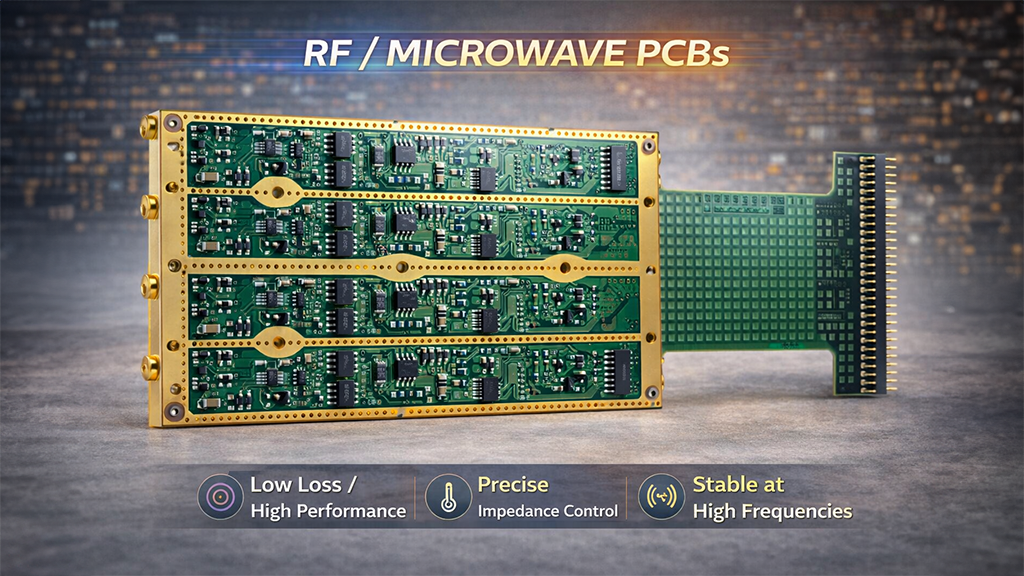
RF and microwave PCBs deliver performance benefits that standard PCBs cannot achieve.
Advantages include:
- Minimal signal loss at high frequencies
- Stable impedance across operating ranges
- Faster data transmission with reduced latency
- Support for wide bandwidth and multi-channel systems
- Compact, high-density packaging capabilities
Reliable operation in sensitive environments
Applications of RF / Microwave Printed Circuit Boards
RF and microwave PCBs are foundational to modern high-frequency technology.
Applications include:
-
5G, Wi-Fi, Bluetooth,
and satellite communications
-
Radar and defense
systems
-
Medical imaging equipment
such as MRI and CT scanners
-
Automotive radar,
sensors, and communication modules
-
Industrial sensing
and security systems
-
High-frequency
consumer electronics
These applications depend on precision signal control and noise-free operation.
Why Choose Circuitek Solutions Inc. for RF / Microwave PCB Fabrication?
Circuitek Solutions Inc. is a trusted RF/Microwave PCB manufacturer in USA, delivering high-frequency PCBs engineered for performance-critical applications.
We specialize in:
- RF and microwave material expertise
- Controlled impedance PCB fabrication
- Precision trace and spacing control
- Advanced surface finishes for signal integrity
- Hybrid material stackups
- Prototype to production-scale manufacturing
Our engineering-driven processes ensure consistent quality, reliability, and performance in high-frequency environments.
FAQ SECTION
RF and microwave PCBs are designed for high-frequency signal transmission and require specialized materials, controlled impedance, and tight tolerances to maintain signal integrity.
Standard FR-4 has higher dielectric loss at microwave frequencies, which can lead to signal attenuation and performance degradation.
Industries such as telecommunications, aerospace, defense, medical imaging, automotive radar, and satellite communications rely heavily on RF and microwave PCBs.
Impedance control is critical in RF and microwave PCBs to prevent signal reflections, loss, and interference that can compromise system performance.