

Rigid PCB Manufacturer in USA
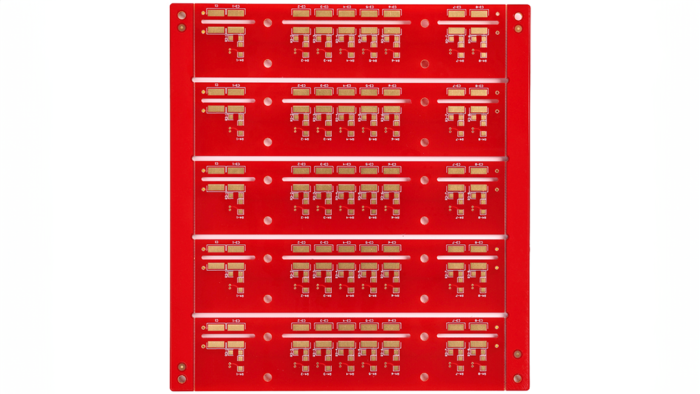
At CircuiTek Solutions, we produce Rigid PCB, they play a critical role in powering today’s “smart” electronics — from consumer devices to advanced industrial and aerospace systems. While newer PCB technologies continue to emerge, rigid printed circuit boards remain the most widely used PCB type due to their reliability, stability, and manufacturing efficiency.
Rigid PCBs form the foundation of countless electronic products, providing the structural and electrical backbone required for both simple and highly complex applications.
What Is a Rigid PCB?
A rigid PCB is a solid, inflexible printed circuit board that maintains its shape and structure throughout its service life. Unlike flexible or rigid-flex boards, rigid PCBs cannot be bent or folded, making them ideal for applications that demand mechanical stability, consistent electrical performance, and long-term durability.
Rigid PCBs are commonly manufactured as:
- Single-sided boards
- Double-sided boards
- Multilayer boards (up to 40 layers)
- Mechanical spacer boards
- Specialized carrier boards
A qualified rigid PCB manufacturer offers multiple configurations depending on design complexity, performance requirements, and end-use environment.
Materials Used in Rigid PCB Manufacturing
Rigid PCBs can be manufactured using a wide range of substrate and core materials, each selected based on electrical, thermal, and mechanical requirements.
Common materials include:
- Standard FR-4 (most widely used)
- High-TG FR-4 for elevated temperature applications
- High-speed and low-loss materials
- Copper core materials
- Ceramic substrates
- PTFE materials for RF and microwave designs
Each material offers unique characteristics related to signal integrity, thermal performance, and dimensional stability.
Technical Aspects of Rigid PCB Design and Manufacturing
Rigid PCB manufacturing involves numerous technical considerations that directly impact performance and reliability.
These include:
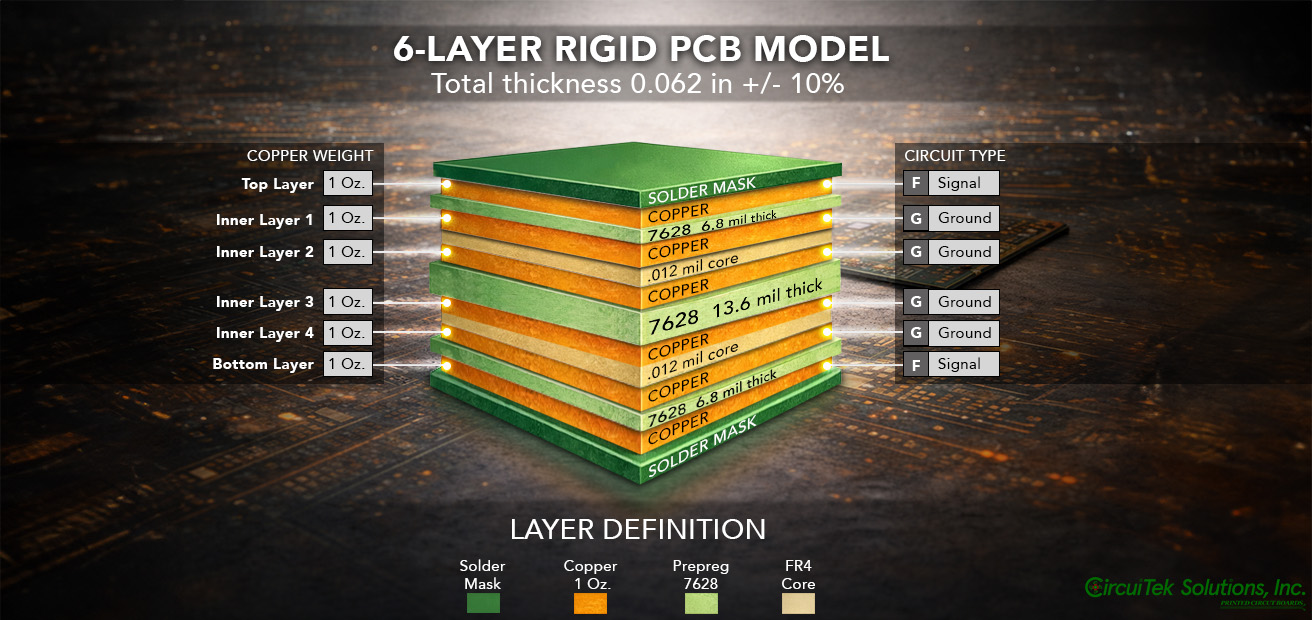
Layer count
1 to 40 layers
Design complexity
Through-hole to advanced HDI designs
Via structures
Blind, buried, via-in-pad (filled or capped)
Impedance control requirements
Copper thickness variations
Material selection from standard to specialized laminates
Technology integration
HDI, RF, microwave, metal core, hybrid constructions
Surface finishes and solder mask options
Technical Aspects of Rigid PCB Design and Manufacturing
Rigid PCB manufacturing involves numerous technical considerations that directly impact performance and reliability.
These include:
- Layer count: 1 to 40 layers
- Design complexity: Through-hole to advanced HDI designs
- Via structures: Blind, buried, via-in-pad (filled or capped)
- Impedance control requirements
- Copper thickness variations
- Material selection from standard to specialized laminates
- Technology integration: HDI, RF, microwave, metal core, hybrid constructions
- Surface finishes and solder mask options
Rigid PCBs may also be produced as mechanical spacer boards or carrier boards to support assemblies requiring precise spacing, alignment, or structural reinforcement.
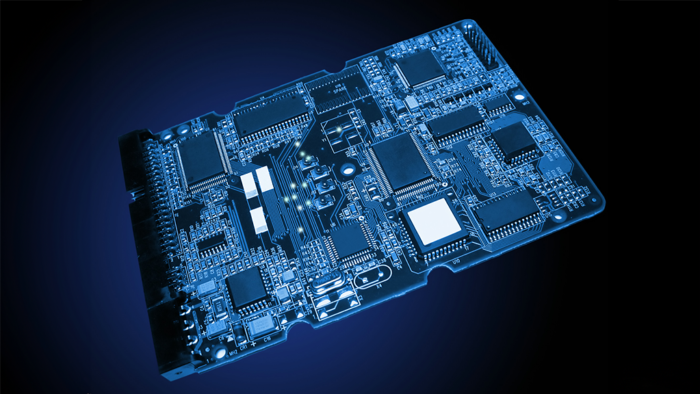
Key Features of Rigid Printed Circuit Boards
Rigid PCBs remain the backbone of the electronics industry due to several proven advantages.
Stiffness and Rigidity
Once manufactured, rigid PCBs retain their shape and cannot be bent or flexed, ensuring stable component mounting.
Solid Substrate Material
FR-4 substrates provide excellent electrical insulation, mechanical strength, and thermal stability while meeting UL 94V-0 flame-retardant standards.
High Functionality
Rigid PCBs support single-layer to multilayer designs, enabling higher current capacity, increased routing density, and complex circuit architectures.
High Reliability
Their structural rigidity makes rigid PCBs resistant to deformation, vibration, and long-term mechanical stress.
Manufacturing Efficiency
As the most established PCB technology, rigid PCBs benefit from highly automated, standardized manufacturing processes, resulting in consistent quality and cost efficiency.
Thermal and Dimensional Stability
Rigid PCBs maintain shape and performance under temperature fluctuations, critical for industrial and high-reliability environments.
Advantages of Using Rigid PCBs
Rigid PCBs offer several advantages over more complex PCB types:
- Lower design and development costs
- Reduced installation and assembly costs
- Proven reliability across industries
- Broad material and technology compatibility
- Cost-effective scalability from prototype to production
Because of these advantages, rigid PCBs are used extensively in applications ranging from consumer electronics to mission-critical military systems.
Applications of Rigid PCBs
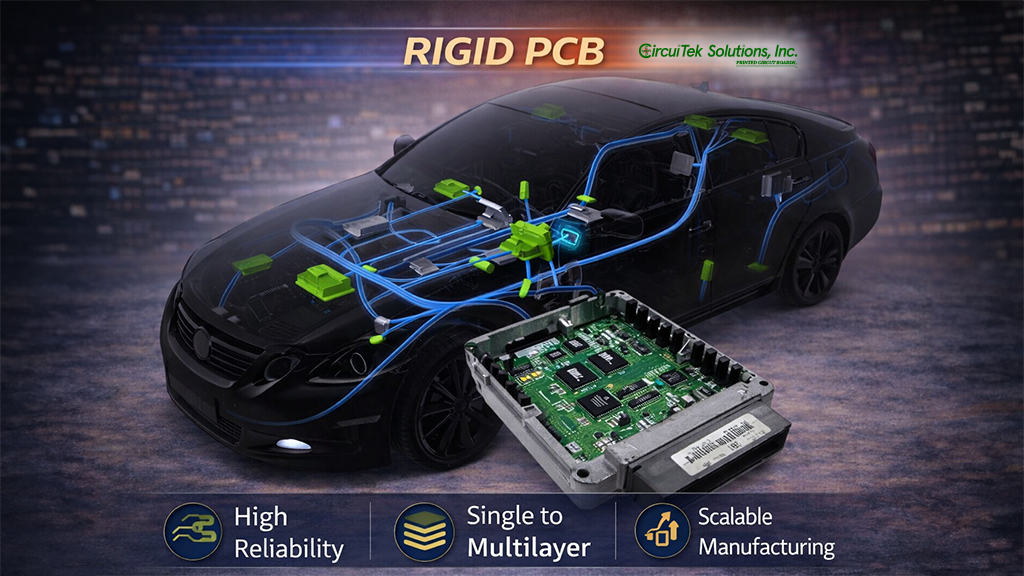
Rigid printed circuit boards are used across virtually every electronics sector, including:
-
Consumer electronics
-
Industrial control systems
-
Medical devices
-
Military and aerospace equipment
-
Computer motherboards and storage devices
-
Telecommunications equipment
Their versatility and durability make them suitable for both high-volume commercial products and specialized, high-reliability systems.
Why Choose Circuitek Solutions Inc. for Rigid PCB Manufacturing?
Circuitek Solutions Inc. is a U.S.-based rigid PCB manufacturer delivering custom printed circuit boards built to exact specifications and industry standards.
We specialize in:
- Quick-turn prototyping
- Low- to high-volume production
- 2–40 layer rigid PCBs
- Via-in-pad (conductive, non-conductive, copper-plugged)
- Heavy copper designs
- Controlled impedance boards
Advanced surface finishes, including:
- ENIG
- ENEPIG
- Hard Gold Fingers
- Wire-bondable electrolytic gold
- Immersion Tin
- Immersion Silver
- HASL and LF HASL
Our engineering-driven manufacturing approach ensures consistent performance, durability, and compliance across diverse operating environments.
EEAT + SEARCH-DRIVEN
Rigid PCBs are solid and inflexible, providing strong mechanical support, while flexible PCBs are designed to bend or fold. Rigid PCBs are preferred when stability, durability, and cost efficiency are priorities.
Rigid PCBs can range from single-layer designs to complex multilayer constructions with up to 40 layers, depending on electrical and mechanical requirements.
Rigid PCBs are widely used in consumer electronics, automotive systems, industrial controls, medical devices, telecommunications, and aerospace applications.
Material selection depends on factors such as operating temperature, signal speed, mechanical stress, and regulatory requirements. A qualified rigid PCB manufacturer can help evaluate these factors during the design phase.